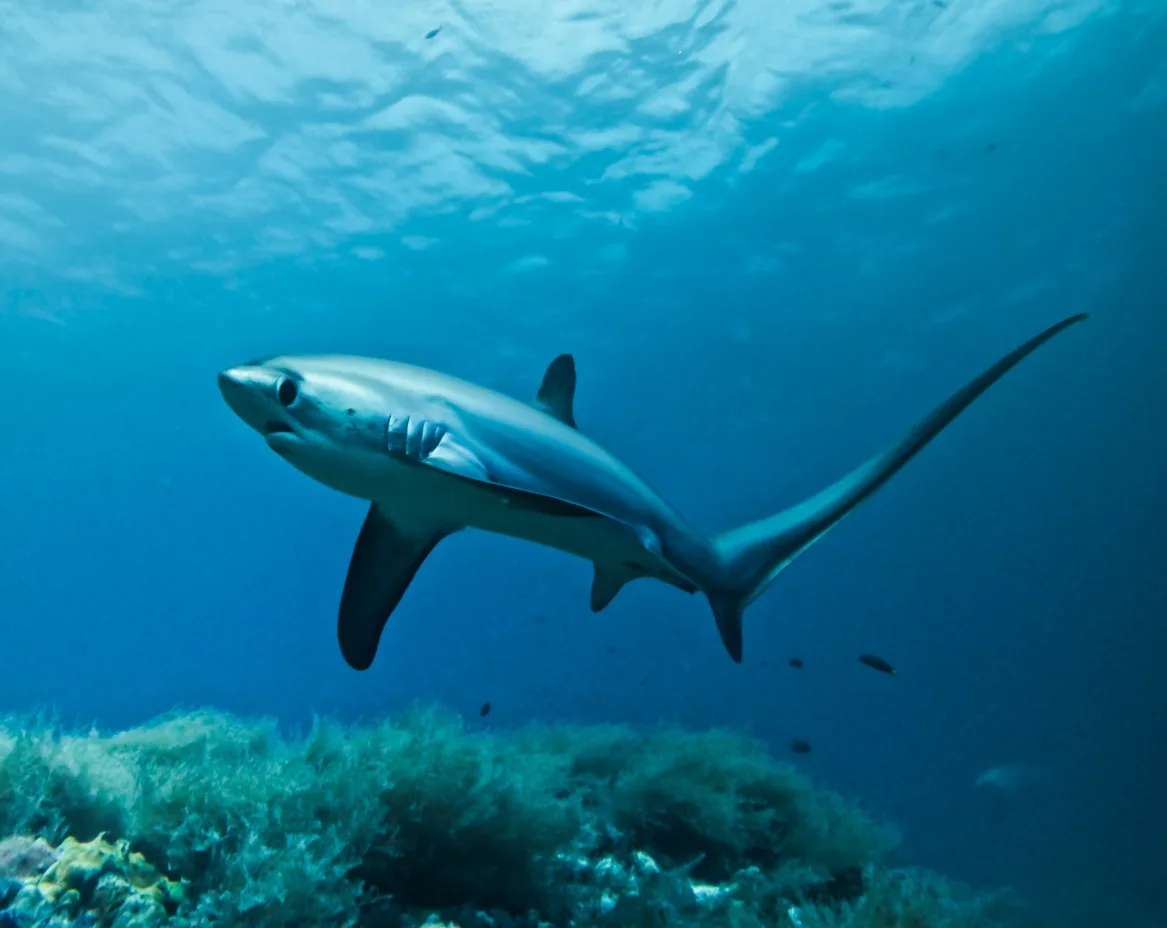


The thresher shark cleaning station Malapascua divers may visit is at Monad Shoal, where research has documented pelagic threshers interacting with cleaner wrasse. The wrasse inspect the sharks and remove parasites and dead tissue. A shark may circle slowly over a cleaner territory and lower its tail fin in a posture that may help the fish inspect it. The station describes a natural interaction, not a guaranteed shark encounter.
What makes this behaviour interesting is its quiet, unhurried nature. The shark visits a place where cleaner fish work, and the fish inspect it. Understanding the exchange can help you recognise what is happening without expecting a dramatic pass, a close approach, or a hunt.
What is a shark cleaning station?
A cleaning station is a particular place on the reef where cleaner fish inspect visiting animals. Here, cleaner wrasse remove parasites and dead tissue from pelagic threshers. The shark is often described as the client, while the wrasse do the inspection. It is an interaction between two species, rather than a feeding display arranged for divers.
The location matters because the cleaner fish work in a specific territory. A station can be there even when no shark is visiting, or when a shark is present but not being cleaned. The term describes a place where the interaction can happen. It does not promise that a shark will arrive on cue or remain there while divers watch.
That distinction is useful when thinking about a dive. A cleaning station is not simply another name for a place where sharks are guaranteed to appear. It describes a natural behaviour and the place where researchers have documented it. The animals determine whether the interaction happens during any particular visit.
Why pelagic threshers visit Monad Shoal
Pelagic threshers are associated with oceanic habitat, but they can also visit coastal seamounts. Monad Shoal, off Malapascua, is one such site. Research there has documented pelagic threshers interacting with cleaner wrasse, bringing the shark and the cleaner fish together at the station.
The cleaning has a practical role for the shark. As the wrasse inspect it, they remove parasites and dead tissue. The visit also gives the cleaner fish feeding activity. This exchange is different from hunting: the shark is moving through a cleaner territory while the fish inspect it, rather than pursuing prey.
That is why “cleaning station” describes more than a shark location. It identifies a particular relationship between the visiting shark and the cleaner fish in their territory. The station may be present, but wildlife activity varies. Divers cannot summon the interaction or determine when a shark will arrive.

What the cleaning behaviour looks like
One documented sign is slow circling over a cleaner territory. Rather than moving quickly through the area, a shark may circle above the fish. Researchers have also recorded threshers lowering the tail fin in a posture that may facilitate inspection by cleaner wrasse. These movements can be subtle. The useful thing to notice is the shark’s position over the cleaner territory and the fish working around it.
The lowered tail is not, by itself, evidence of a hunting display. During cleaning, the shark’s posture may allow the wrasse to inspect it. Watching the relationship between shark and cleaner fish gives the behaviour its context: the animal is over a cleaner territory, and the fish are carrying out their inspection.
A thresher’s elongated tail has a separate role in hunting. Research has documented tail-slaps used to strike prey, and threshers can use the tail to stun schooling fish. That behaviour is distinct from lowering the tail during a cleaning interaction. A cleaning-station dive should not be treated as a likely opportunity to watch a hunt.
Keeping those behaviours separate helps avoid reading too much into a single movement. A lowered tail in the documented cleaning context may facilitate inspection; a tail-slap is associated with striking prey. The cleaning station is about the shark and cleaner wrasse interacting, not a promise of fast action.

Why timing and patience matter
Research discussing the Philippine seamount reports greater cleaning-station visitation during early daylight hours, associated with cleaner fish feeding activity. PADI also describes Malapascua threshers as more active in the early morning. This helps explain why early daylight is relevant to observation, but it does not create a fixed arrival time.
Wildlife activity varies. A shark may not be present when divers arrive, or it may be there without cleaning. Even during a period when station visits are reported more often, no particular encounter can be promised. The research describes a pattern, not a schedule for individual sharks.
Patience means allowing the interaction to unfold if it happens, rather than expecting a particular movement or duration. If there is no shark at the station, there is no cleaning behaviour to watch at that moment. The station belongs to the animals, and its activity is not under human control.
How to observe without disrupting the sharks
Keep a respectful distance and avoid moving closer to force a better view. A study recorded a thresher leaving after divers interrupted its behaviour, and close approaches can disturb sharks at cleaning stations. The best observation is not necessarily the closest one. Give the shark room to continue its natural behaviour without being pressed by divers.
If a shark changes direction or leaves, do not pursue it to regain a view. Following an animal that has moved away would add pressure rather than allow the interaction to continue on its own terms. Stay back, do not touch the shark or reef, and watch from a position that does not require closing in.
Focus on the details that are already visible: a slow circle, a lowered tail fin, or cleaner wrasse inspecting the shark. These behaviours may be less dramatic than a fast pass, but they explain what the station is for. There is no need to encourage the shark to stay or to approach it for a closer look.
Responsible thresher shark diving means treating the encounter as wildlife observation, not a performance. The shark may leave, remain at a distance, or not appear at all. Respecting that uncertainty protects the natural character of the encounter and avoids turning a close approach into a disturbance.
Planning a thresher-shark dive from Malapascua
Monad Shoal and Kimud Shoal provide different site context for shark diving. Our comparison of Monad Shoal and Kimud Shoal explains how the two sites differ. For the cleaning-station interaction described here, Monad Shoal is the relevant place because research has documented pelagic threshers interacting with cleaner wrasse there.
Our guided Malapascua shark dives include two Kimud Shoal thresher-shark dives and one Monad Shoal dive. These shark dives are for certified divers holding Advanced Open Water or higher. The trip visits both shoals, but thresher and tiger shark sightings depend on natural wildlife activity and cannot be guaranteed.
For current requirements or details for your dates, message us. Go ready to observe the behaviour that is actually happening, rather than expecting a particular sighting. If a thresher visits a cleaning station, the slow circling and cleaner wrasse at work are worth noticing in their own right.